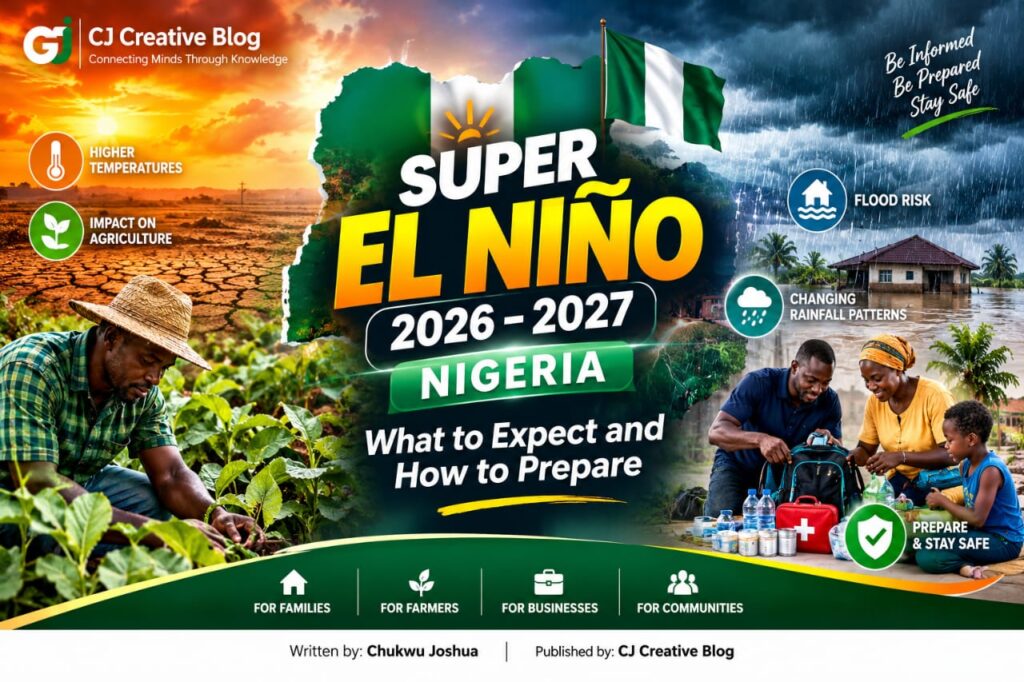
What Nigeria Should Expect and How to Prepare
Author: Chukwu Joshua
Publisher: CJ Creative Blog
Tagline: Connecting Minds Through Knowledge
Introduction: Why Nigerians Should Pay Attention
Scientists are monitoring an exceptionally strong El Niño event that could influence global weather patterns into 2027. For Nigerians, the important questions are simple: What could happen, how might it affect our daily lives, and what can we do now to reduce the risks?
El Niño is a natural climate pattern involving unusually warm surface waters in the tropical Pacific Ocean. These changes affect atmospheric circulation and can influence rainfall and temperatures in different parts of the world.
According to NOAA's October 8, 2026, assessment, a strong-to-very-strong El Niño is likely to persist through January–March 2027. However, this does not mean Nigeria is guaranteed to experience a particular disaster.
The effects depend on regional weather conditions and other climate factors.
The message is simple: Nigerians should prepare intelligently, follow official forecasts, and avoid panic.
1. What Is Super El Niño?
El Niño occurs when the central and eastern tropical Pacific Ocean becomes warmer than usual, changing wind patterns and the distribution of rainfall.
The term Super El Niño is an informal description of an exceptionally strong event. It is not an official category that guarantees specific consequences.
El Niño is different from climate change. El Niño is a natural climate pattern, while human-caused climate change refers to long-term global warming driven mainly by greenhouse gas emissions. Both can influence the conditions in which extreme weather occurs.
A brief history
Previous strong El Niño events, including those of 1997–1998 and 2015–2016, influenced weather patterns across several continents. Their effects varied by region, with some areas experiencing drought and others facing unusually heavy rainfall.
These historical events demonstrate why preparation matters. However, their impacts cannot be used to predict exactly what Nigeria will experience in 2026–2027.
2. What Could Nigeria Expect in 2026–2027?
Nigeria should pay attention to three major areas: temperature, rainfall, and the consequences for agriculture and daily life.
NiMet's 2026 Seasonal Climate Prediction, published on February 10, anticipated generally above-normal temperatures across much of Nigeria, alongside variable rainfall conditions and possible prolonged dry spells in some locations. NiMet's August update subsequently confirmed that a strong El Niño was developing. Because the original seasonal prediction preceded this development, Nigerians should check for newer official updates rather than assuming the earlier outlook captures every possible effect.
Potential concerns include:
- Higher temperatures: Hot conditions can increase discomfort, dehydration risks, and demand for water and electricity.
- Changes in rainfall: Some areas may experience dry spells, while others may receive substantial rainfall.
- Agricultural challenges: Changes in rainfall timing and heat stress can affect crops, livestock, and farming decisions.
- Flooding in vulnerable communities: Heavy rainfall can cause flooding where drainage is inadequate or rivers overflow.
- Household and business disruption: Extreme weather can damage property, interrupt transport, and affect livelihoods.
These are risks to prepare for, not confirmed outcomes for every Nigerian state.
What about flooding?
Flood risk deserves attention regardless of whether El Niño is responsible for a particular rainfall event.
Nigeria's Hydrological Services Agency (NIHSA) published its 2026 Annual Flood Outlook on April 15, identifying flood-prone communities and infrastructure across the country. Residents should consult its outlook and current warnings for their own locations.
3. How Could El Niño Affect Africa?
The effects of El Niño are not the same across Africa.
Southern Africa is particularly vulnerable to drought and heat during certain El Niño events, which can affect crop production, livestock, and water supplies. Other parts of the continent can experience different rainfall patterns, including wetter conditions in some seasons.
For Nigeria and West Africa, the relationship is more complex. People should not assume that every El Niño event will cause nationwide drought, flooding, or food shortages.
The most useful approach is to combine global climate information with forecasts from NiMet and relevant local authorities.
4. What Nigerians Should Do to Prepare
People cannot prevent El Niño itself, but they can take practical steps to reduce the damage caused by extreme weather.
For households
- Follow official weather forecasts and emergency warnings.
- Keep safe drinking water, essential medicines, and emergency contacts available.
- Protect important documents and electrical equipment from water damage.
- Reduce strenuous outdoor activity during extreme heat and drink sufficient safe water.
- Know safer routes and locations if flooding threatens.
- Check on children, older adults, and people who may need additional assistance.
For farmers
- Follow NiMet's seasonal forecasts and local agricultural advisories.
- Consult agricultural extension officers before changing planting dates.
- Choose crops and varieties suitable for local rainfall and soil conditions.
- Improve soil moisture retention and plan water use carefully.
- Prepare for possible heat stress affecting crops and livestock.
- Avoid making costly farming decisions based only on social
-media predictions.
For business owners and workers
- Check roofs, gutters, drainage, and areas where water could enter premises.
- Protect stock, documents, machinery, and electrical equipment.- Plan for possible disruptions to transport, deliveries, and daily operations.
- Provide drinking water, shade, and rest breaks for outdoor workers during hot weather.
For communities
- Clear drainage channels safely and lawfully before heavy rainfall.
- Identify flood-prone roads and evacuation routes.
- Share verified warnings rather than unconfirmed predictions.
- Protect drinking
-water sources and maintain proper sanitation.
- Support people who may struggle to prepare or evacuate independently.
5. Where Nigerians Can Get Reliable Information
Do not rely on sensational headlines or forwarded messages alone. Use official sources for information relevant to your location.
- NiMet: "nimet.gov.ng" (https://nimet.gov.ng/) — weather forecasts and seasonal climate information.
- NIHSA: "nihsa.gov.ng" (https://nihsa.gov.ng/) — flood outlooks and hydrological information.
- NOAA Climate Prediction Center: "cpc.ncep.noaa.gov" (https://www.cpc.ncep.noaa.gov/products/analysis_monitoring/enso_advisory/ensodisc.shtml) — international El Niño updates.
- World Meteorological Organization: "wmo.int" (https://wmo.int/) — global climate assessments and updates.
Remember that a global forecast cannot tell you precisely what will happen in your community. Local forecasts and emergency instructions should guide your decisions.Conclusion: Prepare, Don't PanicThe anticipated 2026–2027 El Niño deserves attention, but Nigerians should not interpret it as a guarantee of nationwide disaster.
The sensible response is to monitor official forecasts, prepare for relevant local risks, protect livelihoods, and share accurate information. Families can make simple preparations, farmers can use informed agricultural advice, and communities can reduce risks through early action.
We cannot stop El Niño, but we can reduce its potential impact by preparing early and making informed decisions.
For more detailed scientific explanations and international updates, readers can visit the official resources linked above.
SEO and publishing details
SEO title: Super El Niño 2026–2027: Nigeria's Preparation Guide
Meta description: Discover what the 2026–2027 Super El Niño could mean for Nigeria and how families, farmers, and businesses can prepare for weather-related risks.
URL slug: "super-el-nino-2026-2027-nigeria"Primary keyword: Super El Niño 2026–2027 Nigeria
Secondary keywords: El Niño in Nigeria, Nigeria climate forecast 2027, El Niño effects in Africa, heat safety Nigeria, flood preparedness Nigeria, farming and climate risks.
Blog excerpt: Scientists are tracking an exceptionally strong El Niño event that could influence weather patterns into 2027. Learn what Nigerians should know, where to find reliable forecasts, and how to prepare for potential climate risks.
Suggested internal links:
1. How Nigerians Can Prepare for Flooding.
2. Practical Heat-Safety Tips for Families and Outdoor Workers.
3. How Farmers Can Use Seasonal Weather Forecasts.