5 Simple Steps to Write Engaging Content
How to use Hook, Stakes, Turn, Scene and Shatter to create content people want to read, understand and remember.
By Creative Blog Africa
Quick Answer:
What Is Storytelling in Content Writing?
Storytelling in content writing is the use of stories, experiences, emotions and relatable situations to communicate information in a way that captures attention and makes the message easier to understand and remember.
Instead of simply giving your audience information, you present that information through a narrative that makes people curious, connected and interested.
A simple storytelling framework you can use is:
Hook → Stakes → Turn → Scene → Shatter
In this lesson, Creative Blog Africa explains each step in simple language and shows you how to use storytelling in blog posts, social media content, business content, personal branding and other forms of content writing.
Don’t Just Write. Tell a Story.
You have probably seen content that was full of useful information but somehow felt boring.
Maybe the writer knew the topic.
Maybe the grammar was correct.
Maybe the article was well researched.
But you still stopped reading.
Now think about a story someone told you that you still remember.
What made it different?
It probably made you feel something
Maybe you became curious.
Maybe you saw yourself in the situation.
Maybe you laughed.
Maybe you learned something.
That is the power of storytelling.
And if you are learning content writing, this is a skill you should pay attention to.
Because being a good content writer is not only about knowing how to write.
It is about knowing how to communicate an idea to a particular person in a way that makes them want to listen.
What You Will Learn in This Lesson
By the end of this lesson, you will understand:
- What storytelling means in content writing
- Why storytelling makes content more engaging
- How to create a strong content hook
- How to use stakes to make readers care
- How to use a turn to introduce a new idea or discovery
- How to use scenes to make your writing more visual
- How to end content with a powerful takeaway
- How to apply the five-step framework to business content
- How to use storytelling in blog posts and social media
- How to write your own five step story

What Is Storytelling?
Let's make this very simple.
Storytelling means communicating an idea through a story or sequence of events that helps people understand, feel or remember your message.
You don't need to be a novelist.
You don't need to write a movie script.
And you don't need complicated English.
Storytelling can be as simple as explaining:
What happened
What problem came up
What changed
What was learned.
For example:
Without storytelling:
Consistency is important for business growth.
True.
But it doesn't give the reader much to imagine.
With storytelling
For six months, she posted on social media when almost nobody was watching.
Some days, she got two likes.
Some days, none.
She wanted to stop, but she kept going.
Then one of those old posts brought her first major customer.
Now the reader has something to picture.
There is a person.
There is a struggle.
There is a change.
There is a lesson.
That's storytelling.
Why Is Storytelling Important in Content Writing?
If you are learning content writing as a career, storytelling can help you communicate more effectively.
And if you are a business owner, storytelling can help you explain your business in a way that people can connect with.
People don't read content in the same way.
They are constantly seeing:
Blog posts
Advertisements
Social media posts
Videos
Emails
Product descriptions
News
Business promotions
So, when you create content, you are competing for attention.
Storytelling can help you make your message more human, relatable and memorable.
It can help you:
Capture attention
Build connection
Explain an idea
Create emotion
Encourage action

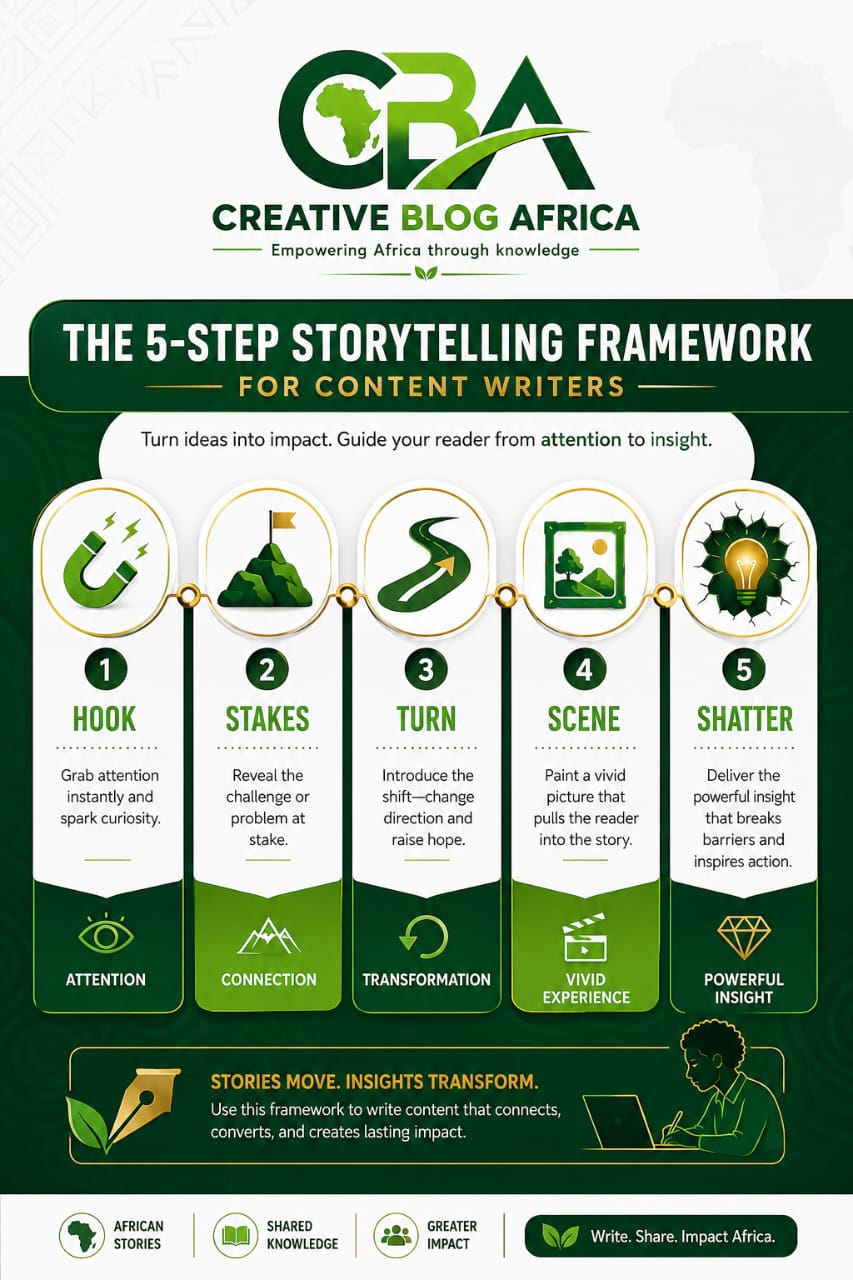
The 5-Step Storytelling Framework
A simple way to structure a story is:
1. Hook
2.Stakes
3.Turn
4.Scene
5.Shatter
Think of it as a journey.
You are taking the reader from:
"Why should I pay?
To
"This matters to me."
then: "Something changed.
"Then: "I can see it.
"And finally, "Now I understand the lesson.
Let's look at each step.

1. Hook: How to Get Your Reader's Attention
A hook is the opening part of your content that makes someone want to continue reading.
In simple terms:
A hook gives the reader a reason to stop.
Imagine you are scrolling through your phone.
You see hundreds of posts.
You don't read everything.
Something has to make you stop.
That is the job of your hook.
Weak opening:
"In this article, we will discuss the importance of storytelling in content writing.
There is nothing wrong with it.
But it doesn't create much curiosity.
Stronger opening:
You can be a good writer and still create content nobody wants to read."
Now you have a question: Why?
That question can keep the reader going.
How can you create a hook?
You can start with:
A question
- A surprising statement
- A common problem
- A personal experience
- A bold opinion
- An unexpected comparison
- A fact
- A statement that challenges an assumption
One useful technique is idea collision.
This means putting two unexpected ideas together.
For example:
"Good content isn't always about good grammar."
The reader may immediately wonder:
"Then what makes content good?"
That's curiosity.
And curiosity is powerful.

2. Stakes:
Give Your Reader a Reason to Care
Getting attention is only the beginning.
Now you need to make the reader care.
That's where stakes come in.
In simple language:
Stakes show why something matters.
They can be:
- A problem
- A risk
- A fear
- A challenge
- A desire
- Something the person could lose
- Something they want to achieve
For example:
General:
Many businesses struggle with social media.
With stakes:
You post almost every day.
You create graphics.
You announce promotions.
But at the end of the month, your followers have increased while your customers haven't.
Now the business owner can relate.
They may think:
"That's exactly what I'm experiencing.
"That is what stakes do.
They make the story personal.

3. Turn:
Show What Changed
The turn is the moment something changes.
It could be:
- A discovery
- A realization
- A mistake
- A new idea
- A solution
- A change in direction
For example:
I kept writing more articles because I thought I wasn't publishing enough.
Then:
I eventually realized the problem wasn't how much I was publishing.
My headlines simply weren't giving people a reason to click.
That's the turn.
The person's understanding has changed.
The story now moves in a new direction.
Why does the turn matter?
Because you don't want to leave your reader inside the problem.
Good educational content should move the reader from:
Problem → Understanding → Possibility
4. Scene:
Help Your Reader See the Story
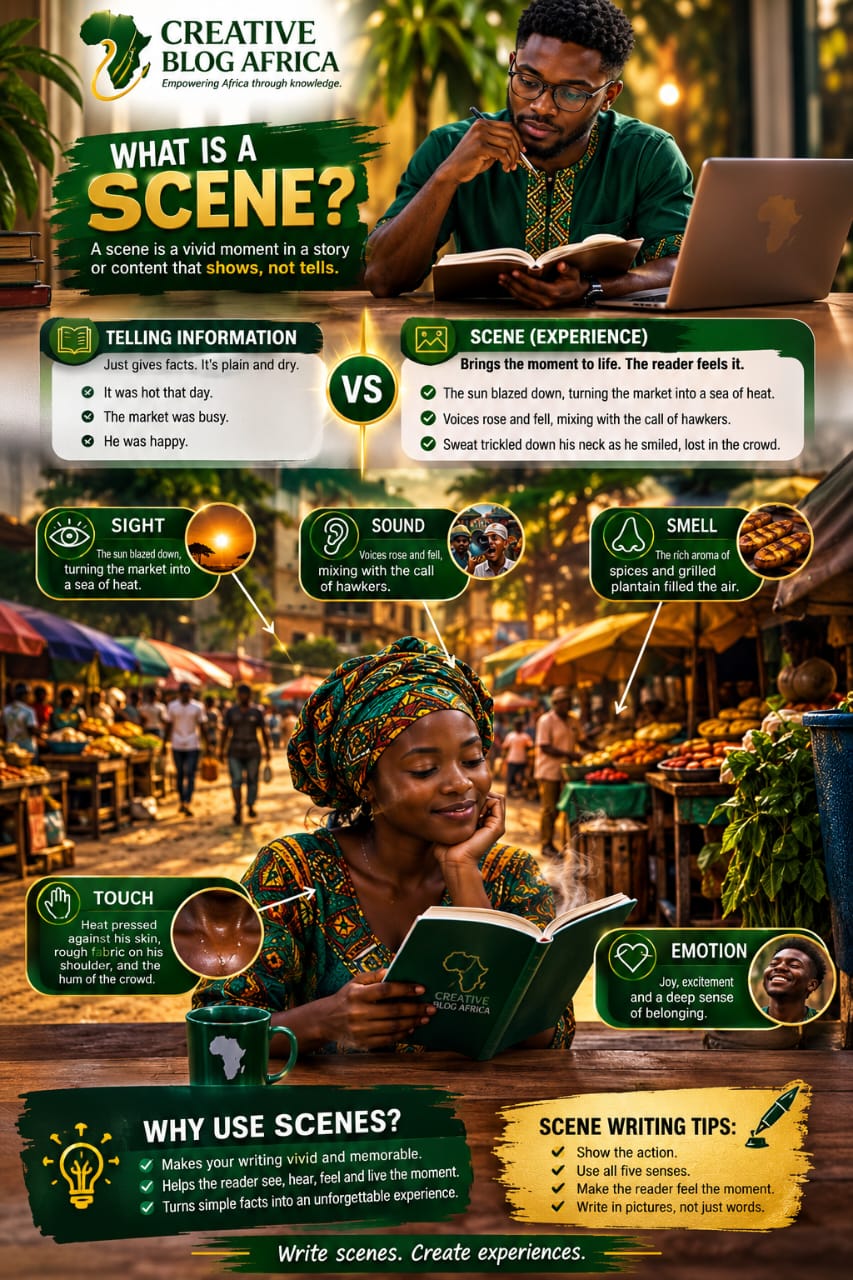
A scene helps your reader imagine what is happening.
Many beginner writers simply tell the reader what happened.
Good storytelling helps the reader experience the moment.
Telling:
She was nervous.
Showing:
She stood beside the laptop, looked at the audience and held her notes tightly because her hands were shaking.
The second example feels more real.
Why?
Because you can see it.
When writing a scene, think about:
What did the person see?
What did they hear?
What did they feel?
What was happening around them?
You don't need complicated vocabulary.
You need specific details.
How to Use Scenes in Business Content
Imagine you are writing for a restaurant.
Instead of:
Our restaurant has a beautiful atmosphere.
You could write:
Warm lights fill the room as soft music plays in the background.
Conversations flow from nearby tables while the smell of freshly prepared food comes from the kitchen.
Now the reader can imagine being there.
That is storytelling.

5. Shatter:
Leave Your Reader with Something to Remember
The final step is Shatter.
In this framework, the shatter is the powerful lesson, realization or insight that changes how the reader sees the story.
Think of it as the:
"Aha!" moment.
For example:
Maybe your content doesn't need more information.
Maybe it needs more humanity.
That is a strong takeaway.
Another example:
People may forget what your business sells, but they are more likely to remember the story that made them care about it.
That's the kind of statement that stays in someone's mind.
Ask yourself:
"What do I want my reader to remember after reading this?
"Your answer can become your shatter.
The Five Steps at a Glance
Step| What It Means| Question to Ask
Hook| Get attention| Why should they stop?
Stakes| Create connection| Why should they care?
Turn| Show change| What changed?
Scene| Make it visual| Can they see it?
Shatter| Deliver the lesson| What should they remember?
The formula:
HOOK → STAKES → TURN → SCENE → SHATTER
How to Use Storytelling in Business Content
Let's make this practical.
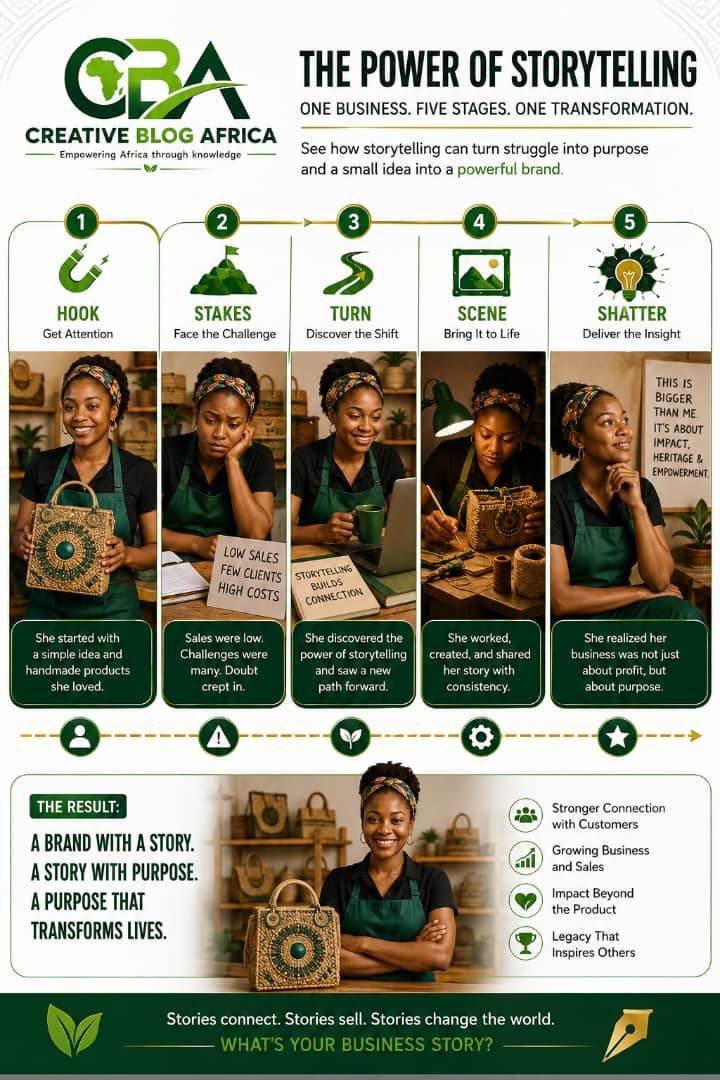
Imagine you are a business owner selling handmade bags.
You could write:
We sell quality handmade bags. Our bags are stylish, durable and affordable.
That's information.
But let's turn it into a story.
Hook
Every bag has a story. This one started with a piece of fabric, a sewing machine and a decision not to give up.
Stakes
The business owner started with little money and struggled to convince people to trust a new brand.
Turn
The owner discovered that customers were interested in knowing how the products were made.
Scene
You describe the sewing machine, the fabric, the late nights, the mistakes and the finished product.
Shatter
She wasn't just making bags. She was turning time, creativity and persistence into something someone could carry.
Now the product has a story.
And the story gives the product meaning.
Where Can You Use Storytelling?
Storytelling can be used across different types of content.
Blog Posts
Use stories to introduce a problem, explain an experience or make a lesson relatable.
Social Media Content
Turn experiences, customer problems and lessons into engaging posts.
Business Content
Explain why your business exists and the problem it wants to solve.
Product Descriptions
Don't only list features. Show how the product can fit into someone's life.
Email Marketing
Start with a situation your reader understands before presenting your message.
Personal Branding
Tell people about your journey, mistakes, lessons and experiences.
Storytelling Does Not Mean Using Big Grammar
If you are a beginner content writer, remember this:
You don't have to sound complicated to sound professional.
Many beginners think good writing means using big English.
It doesn't.
Good writing means:
Being clear.
Being useful.
Being easy to understand.
Instead of:
Furthermore, it is imperative to acknowledge the significant ramifications
You can simply say:
There is something important you need to understand.
Simple writing is not poor writing.
Simple writing is often effective writing.
Write for the person reading your content.
Not for your dictionary.
PRACTICAL EXERCISE:
Write Your Own Story
Now it's your turn.
Choose one:
Option 1 — Personal Story
Write about a time you struggled with something but eventually learned an important lesson.
Option 2 — Business Story
Imagine you own a small business.
Write about why you started it, the problem you wanted to solve and the challenge you faced.
Option 3 — Content Writing Story
Imagine a beginner content writer who writes good articles but nobody reads them.
Tell the story of how they discover storytelling.
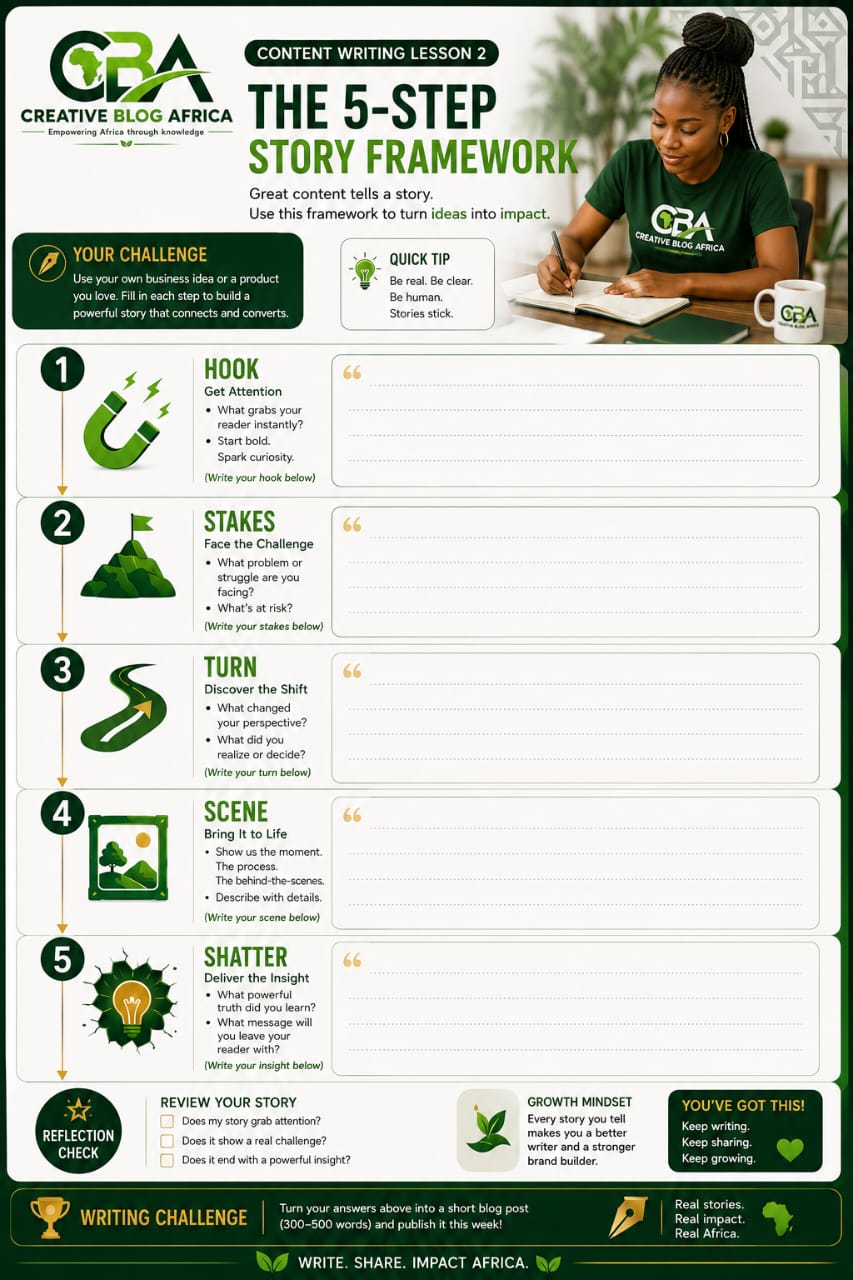
Your Five-Step Storytelling Template
1. HOOK
What will make your reader stop?
Write 1–2 sentences.
2. STAKES
What is the problem, struggle or risk?
Write 2–4 sentences.
3. TURN
What changed?
Write 2–4 sentences.
4. SCENE
What can your reader see, hear or feel?
Write 3–5 sentences.
5. SHATTER
What is the big lesson?
Write 1–3 sentences.
BONUS:
Turn One Story into Multiple Pieces of Content
Here's another skill you should start developing as a content writer.
One idea can become multiple pieces of content.
Your story can become:
- A blog post
- A Facebook post
- An Instagram caption
- A LinkedIn post
- An email
- A short video script
- A carousel
- A newsletter
For example, the same business story can become a detailed blog article and then be shortened into a social media post.
This is called content repurposing.
And learning how to do this can help you create more content without starting from zero every time.
Storytelling Checklist for Content Writers
Before publishing your next piece of content, ask yourself:
Hook
Did I give the reader a reason to stop?
Stakes
Did I give them a reason to care?
Turn
Did something change or did the reader discover something new?
Scene
Can the reader picture what happened?
Shatter
Did I leave them with something worth remembering?
If you can answer yes to these questions, you are thinking beyond basic writing.
You are thinking like a storyteller.
Thanks for reading to the end Now over to you:
1. What’s one thing you’re taking away from this?
2. Would you like more storytelling/content writing tips like this?
Drop your answer in the comment section.
Let’s learn together.
And if this helped you, please share it with a friend.
     |    |   |